

Analyzing soils for sustainable construction
At GMT Lab, we perform a range of tests to understand the behaviour of soils and rocks before, during or after a construction project.
These analyses determine whether the ground is stable, solid and compliant enough to support a structure (house, road, building, etc.).
Consolidation test (oedometer)
This test measures how a soil settles when subjected to a load, such as a foundation.
We reproduce in the laboratory the pressure a building would exert on the soil to see whether it may settle over time.
Soil sample extraction and preservation
We collect undisturbed soil samples using special tubes so they can be analyzed without being damaged.
These samples can be stored for up to one year, allowing additional tests to be performed if needed.
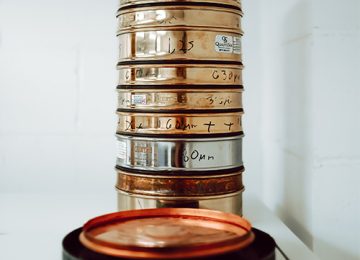
Grain-size analysis (sieving and washing)
We separate soil particles using sieves to determine the size and proportion of the grains (sand, silt, clay).
This test reveals whether a soil is too fine, too coarse or well graded, according to Quebec standards.
Liquid limit and plastic limit
These tests measure the behaviour of soil when wet.
They show the point at which a soil shifts from solid to plastic or liquid — essential information to determine whether it will be stable or slippery on a worksite.
Compressive strength (on rock cores)
We test the strength of rock by subjecting it to high pressure until it breaks.
This determines the rock’s strength and whether it can serve as a foundation or requires reinforcement.
Shear strength
This test measures the force needed for the soil to deform or slide under a load.
It is a key data point for evaluating slope or foundation stability in clay or wet soils.
Sedimentation and water content
We analyze the finest portion of the soil (silt and clay) by sedimentation in water, then measure the amount of water contained in the soil.
These tests determine the moisture level and compactness of the soil, two factors essential to stability.
Organic matter content
We measure the amount of organic matter (such as roots or humus) present in the soil.
Excess organic matter can make the soil unstable and unsuitable for construction.
- Determine the stability and strength of the soil before any construction.
- Assess the quality of the rock and materials extracted from the site.
- Mitigate the risks of settlement, bearing capacity failure and slope instabilities.
- Provide clear and reliable data for the design of safe and durable foundations.
FAQ
Because it tells you whether the soil can support the weight of the structure.
A geotechnical study identifies the composition of the ground, the presence of water, compactness and the risk of settlement.
This helps in designing suitable foundations and avoiding future stability issues.
GMT Lab accepts a variety of samples related to construction materials: soils, granular materials, concrete, asphalt and other materials used in geotechnics or civil engineering.
For any specific material, our team can confirm feasibility and guide you through preparation and shipping.
Our tests include, among others:
grain-size analysis (size of soil grains),
water content and organic matter content,
shear and compressive strength,
oedometer consolidation (soil settlement under load),
and soil permeability.
These analyses provide a complete picture of the quality and behaviour of the soil.
In general, you should allow between 1 and 2 weeks depending on the complexity of the site and the number of tests required.
The laboratory analysis results are then compiled in a complete and detailed report delivered to the client.
Our services are aimed at property owners, developers, engineers, contractors and municipalities who wish to validate the safety of a site prior to construction, development or environmental compliance work.